


I stood up in front of a room full of franchise owners and told them that the thing paying for their growth was about to stop working.
It was my second annual meeting with the company. I had been watching what AI was starting to do to search, and I had convinced myself that the whole foundation underneath us was going to move: search as we knew it, the way we practiced SEO, and Google Ads as a dependable machine you fed money into. I did not think it would erode politely over a decade. I thought it was going to break.
So I said that. On a stage, to a room of people whose mortgages were attached to the current system working.
I got in trouble for it. Not immediately, and nobody threw anything, but the message came back clearly enough. I had frightened people. I had stood in front of a room of owners and told them the ground was moving without telling them where to stand.
I knew better. I know the 1-3-1 rule: one problem, three options, one recommendation. I did not use it that day, and for a long time I told myself it was because I needed to be honest. They had to know.
That was true. It was not the whole truth. I was proud that I saw what was coming. I wanted to be right, and I wanted the room to know it.
Here is what I actually think now, and it took me a while to get here.
I did not lose credibility because I was wrong. I lost credibility because I had no answers. I had no plan. I brought a room a problem and left them holding it.
That is a specific kind of uselessness and I had not encountered it in myself before. A warning without a next step is not leadership. It is just fear, delivered with confidence, by somebody who gets to go home afterward.
The question I still have is whether anybody had the plan then. I am not sure anyone did. I am not certain anyone does now, given how new all of this is.
What I did eventually find was not clever, which is probably why it took me so long to trust it. The answer turned out to be the unglamorous work: clarify the brand, build the reviews, make the company easy to understand, and make sure a customer could find it and verify it in every place they might look. Trust, built where people could check it, before we needed them to believe anything.
It was the unglamorous version. It worked.
And then I did something that still makes me wince.
I restarted my own company, and I built.
I built websites, tools, engines, frameworks and dashboards, and I registered the domains to hang them on. I could have shown you the whole architecture and defended every piece of it, and I would have been articulate about it, because I had thought about all of it carefully.
I had already watched execution get cheap four separate times by then. It started with desktop publishing, when I was a teenager and the skill I had turned into a menu command, and then it happened again to websites, to search, and to content. I knew the pattern. I have taught the pattern. If you had asked me at the time what happens to a business whose value is that it can build things, I would have told you exactly what happens to it, and I would have been right.
I built anyway. Because building was the product I knew how to make.
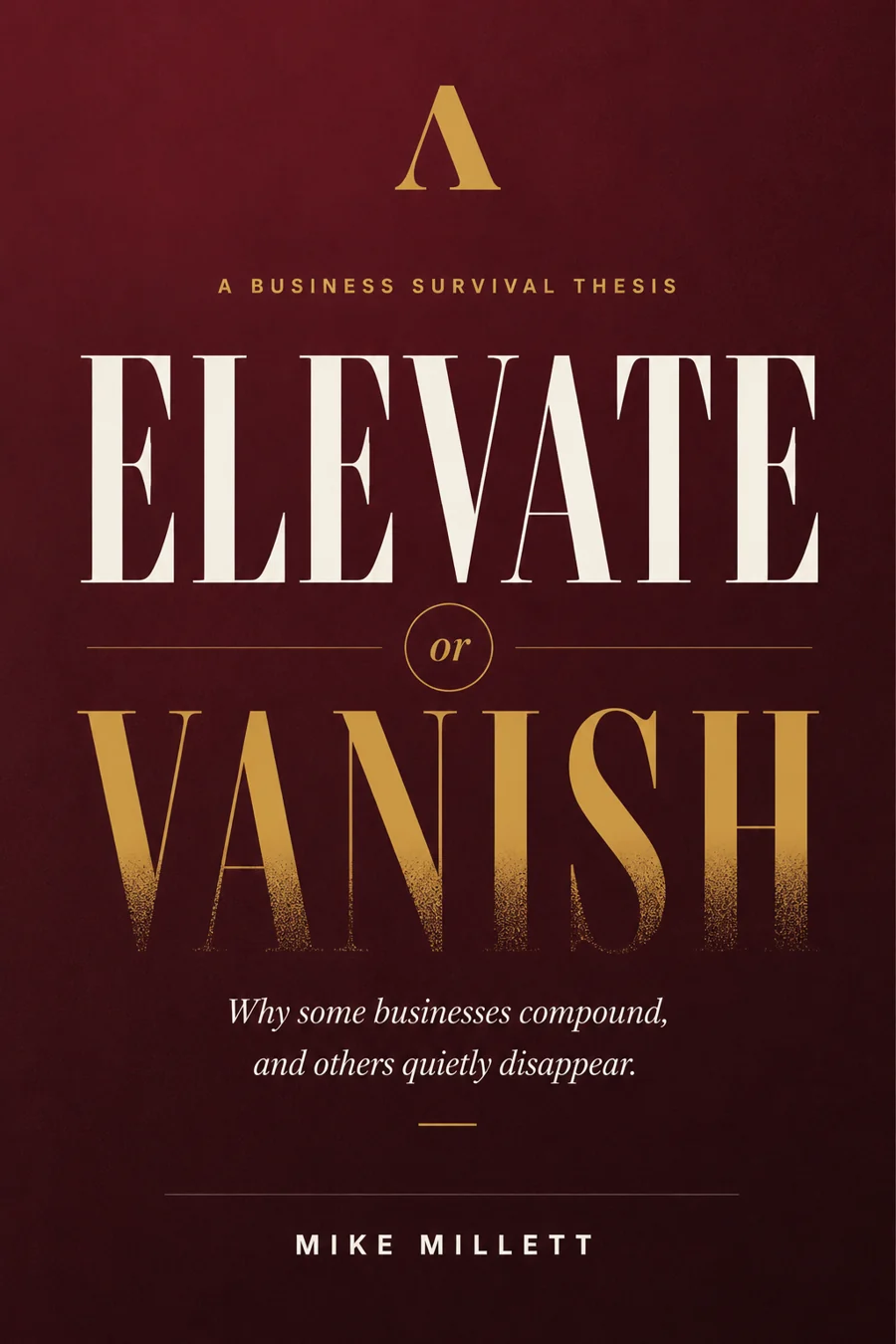
That is the reason this book exists, and it is the reason it is written the way it is. I am not standing outside the problem explaining it to businesses that keep falling into it. I keep falling into it. I catch myself doing the thing I warn other people about, usually a few months after I have done it, usually by accident, usually while looking for something else.
So this is not a book about how to be smarter than the market. I do not have that. It is a book about a pattern I have now watched from the inside for nearly four decades, and about how expensive it is to notice it late.
The argument is one sentence.
Trust creates momentum. Customers move toward brands they trust.
Everything else here is an attempt to say why that is true, what it costs to ignore, and what it asks of you when the market underneath your business moves again, which it is going to.
There is one more thing the argument rests on, and it is the reason the word elevate is in the title rather than something calmer like improve. A business does not only have to get better than it was. It has to keep pace with an environment that keeps moving whether or not the business does. Standing still is not a neutral act. It is a slow change of position relative to everything around you, and it does not announce itself while it is happening.
Six parts. Confusion is expensive. Trust compounds. The market moves faster than businesses evolve. Fragmented brands create fragmented trust. Visibility is no longer optional. And then the decision every business eventually arrives at, which is the title.
There is a proof section at the end, and it is unusually careful. It separates what I can document from what I believe contributed to it and from what I cannot honestly isolate. Most business books do not do that, and I think that is why most business books are hard to believe.
It is free. There is no email gate and nothing to sign up for. If it earns your attention, the rest takes care of itself.
 Mike Millett